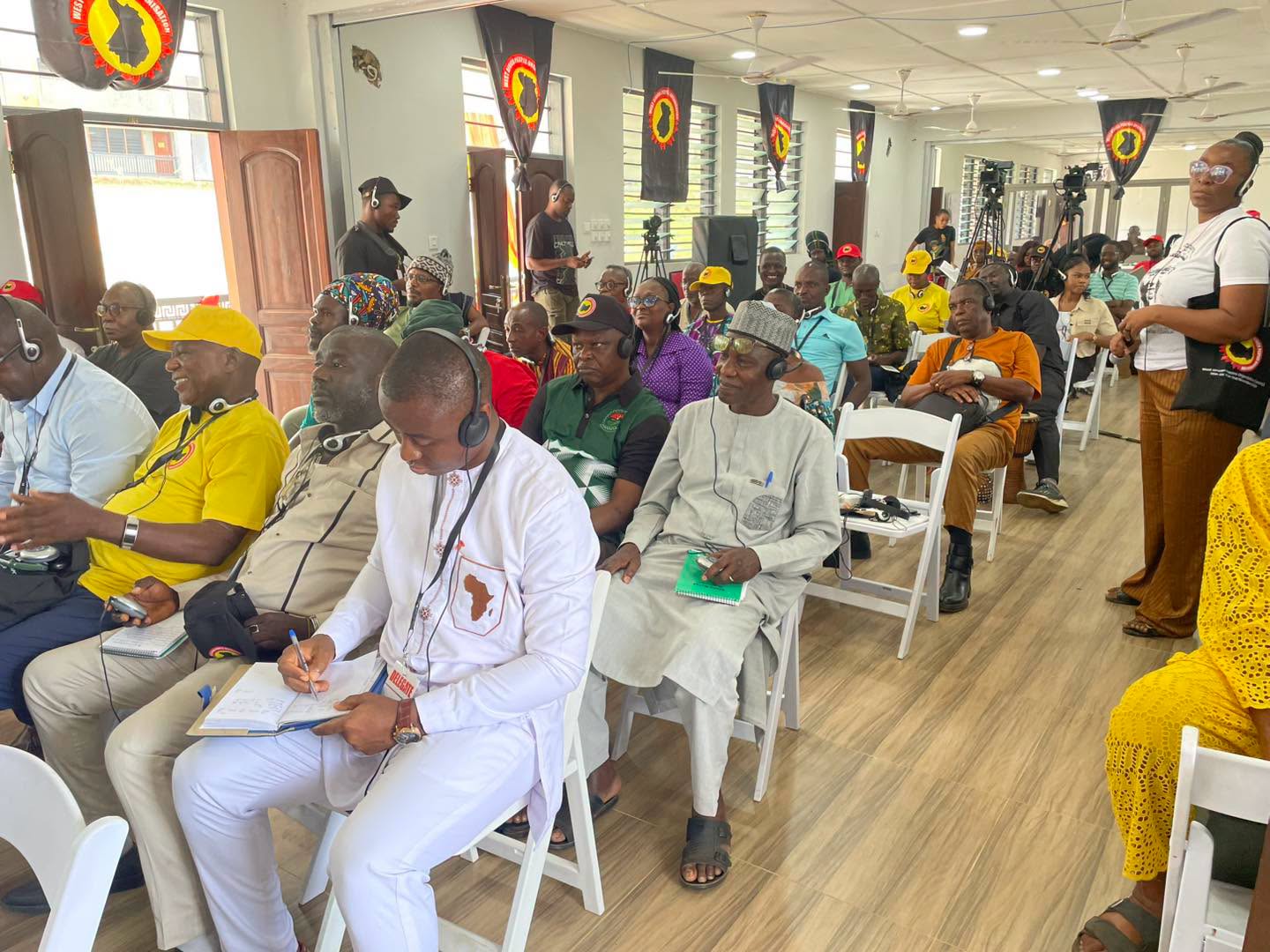
The 2nd delegate congress of WAPO took place on the 31st of October to the 1st of November 2026 at theAmilcal Cabral School (ACS) in Aburi (Agyanoa), Eastern region Ghana under the broad theme “One people, One Struggle against Imperialism for popular power in West Africa”.
The theme of the congress, “One people, One Struggle against Imperialism for popular power in West Africa”, provided the premise and opportunity for the organization to review its activities and achievements over the 2022-2026 period, assess the political and economic realities confronting the West African sub-region and establish its strategic priorities for the next four years.
The congress brought together representatives of the working class, political activists of the left, political movements, Trade Unionists, Women’s groups, Youth organizations, Progressive forces, Anti-Imperialists movements and aligned federations from across West Africa and across the world. The numbers included observers from Africa’s eastern, southern and northern regions and from Latin America.
The gathering comes at a significant moment in West African politics where the region is experiencing crucial political transitions, debates over national sovereignty, growing insecurity in the Sahel, changing relationships with former colonial powers and renewed demands for greater African control over natural resources and economic development and at large a frontal architect of Africa’s global image on the international scene.
Established in the Central Region of Ghana (Winneba), in October 2022, WAPO began with 44 delegates representing 23 organizations from 10 West African countries. Its founding objective was to establish a common platform through which progressive political and social organizations could coordinate their struggles, strengthen regional solidarity and advance a people-centred vision of African unity.
The 2026 Congress kicked off with the arrival and settling in of guests on Friday the 30th and fully initiated on the 31st of November with welcoming and introductory protocols.
The Second Congress therefore represented both an assessment of the organisation’s development and an attempt to reposition its political and organizational work in response to contemporary challenges.
Opening discussions and political direction
The opening programme featured a welcome address by Kyeretwie Opoku, Convenor of the Socialist Movement of Ghana, an address by WAPO President Professor Philippe Toyo Noudjenoume, the presentation of the Secretariat’s quadrennial report and solidarity messages from fraternal organizations. Three commissions; the Constitutional commission, international & regional, and organizational commission were created and tasked with the responsibility of analyzing challenges facing WAPO, including an evaluation of its constitution, measures to expand its membership and how to improve its decision making process.
A significant issue raised during the opening discussions was the question of “Reparatory justice for slavery and its enduring consequences”.

Kyeretwie Opoku argued that reparations should not be reduced to demands for financial compensation from countries that participated in the transatlantic slave trade. Rather, the question should become an instrument for historical education, political consciousness and the mobilization of younger generations around Africa’s historical experience and contemporary struggles.
This discussion was particularly relevant following the adoption of “United Nations General Assembly Resolution A/RES/80/250 on 25 March 2026”, spearheaded by Ghana. The resolution recognized the trafficking of enslaved Africans and racialised chattel enslavement as the gravest crime against humanity.
The congress consequently situated reparations within the broader struggle for African liberation, historical accountability, economic justice and the right of African people to determine their own future and most importantly sharing solidarity with oppressed people of the world including Cuba, Venezuela, the Sahel region, Benin, Swaziland and congratulated Lula Da Silva on his Presidential victory in Brazil.
In his address, Professor Philippe Toyo Noudjenoume emphasized the need for political, economic and cultural transformation across Africa. He raised concerns about the disproportionate resources committed to warfare while millions of Africans continue to face poverty, inadequate healthcare, unemployment and other developmental challenges.
He maintained that, “African resources must serve the needs of African people and called for stronger cooperation among progressive organizations to confront challenges that transcend national boundaries”.
African sovereignty, regional security and the question of imperialism
A major political focus of the congress was the relationship between African sovereignty, economic independence and the continued influence of external powers in the region.
Discussions acknowledged developments in Mali, Burkina Faso and Niger, particularly their efforts to strengthen national control over natural resources, develop domestic industries and establish alternative regional cooperation through the Alliance of Sahel States (AES).
These developments were discussed within the wider context of the struggle against Neo-colonialism and foreign domination.
The congress also addressed the deteriorating security situation in the Sahel and the reported spread of violent extremist activities towards coastal West African countries, including northern Benin and Togo. The discussions highlighted the need for regional cooperation that extends beyond conventional diplomatic arrangements to include organised popular movements, workers’ organisations and communities affected by insecurity.

An important concern emerging from these discussions was that, political independence cannot be considered complete where countries remain economically dependent, unable to exercise meaningful control over their natural resources or vulnerable to evasive external political and military influence.
The broader argument was that African liberation must involve economic restructuring, cultural confidence, political participation and the development of institutions capable of serving the interests of ordinary people.
Organisational achievements and the 2022–2026 Secretariat Report
Presenting the organisation’s quadrennial report, WAPO General Secretary Kafui Kan-Senaya outlined the organisation’s growth and activities since its establishment.
According to the report, WAPO has expanded from 23 member organisations across 10 countries at its founding to 31 organisations across 11 countries.
The report also indicated that 356 cadres, comprising 201 men and 155 women, had received political education and training from the Amílcar Cabral School.
The school serves as an important platform for political education, leadership development and the promotion of Pan-African consciousness among members and activists.
Kafui Senaya, the secretary-General also highlighted WAPO’s collaboration with the International People’s Assembly (IPA), including its participation in organising an anti-imperialist conference in Niamey, Niger, in November 2025.
Engagement with organised labour across Ghana, Nigeria, Liberia, Benin and Côte d’Ivoire was also identified as part of the organisation’s efforts to build relationships with workers and other popular forces. However, the report did not present organisational development without acknowledging its limitations.

Inadequate financial resources were identified as a major challenge affecting the organisation’s ability to conduct regional visits, maintain regular publication of its journal, The Spark, and strengthen communication among member organisations and as well as resolving the colonial erasure of the African identity which has has had generational consequence on the mentality of the people that consequently hinder mobilization and alignment around a common vision.
This admission highlighted an important organisational question: how can a regional movement sustain its political and educational ambitions without adequate financial resources, effective communication structures and consistent grassroots engagement?
Strategic priorities for the next four years
The congress marked the beginning of a new four-year organizational period, with emphasis on consolidating WAPO’s presence and improving its operational capacity.
Among the priorities outlined by the international and regional commission, it condemns repressions across the West Africa Region (Guinea-Bissau, Senegal, Cote D’ivoire, Guinea, Benin, Liberia, Ghana, and Niger), the abduction of President Nicolas Maduro and Celia Flores, Militarism and US-NATO sponsored repressive bilateral agreements that are predatory to the working class and African economies.
The congress opposed the establishment of Western Military base on African soil and called for debt cancellation and the rejection of coercive economic programmes and ultimately expressed solidarity with Cuba, Venezuela and all oppressed people of the world.
The organizational commission emphasized on the strengthening of national structures and improving coordination among member organizations, Expanding membership and developing mobilization strategies. Establishing and strengthening women’s and youth wings, Improving the organization’s media, publications and communication instruments, Deepening relationships with organized labour and other popular movements, Expanding political education through the Amílcar Cabral School and the various in-country member ideolgical schools, Strengthening regional solidarity with progressive organizations and movements facing political repression.
These priorities reflect an understanding that political solidarity must be supported by functional organizational structures.
The proposed women’s and youth wings are particularly important. Their effectiveness will depend on whether they become meaningful spaces for participation, representation and decision-making rather than structures concerned only with mobilization.
Similarly, strengthening national structures will require clear operational responsibilities, communication channels and coordination mechanisms among organisations operating within the same country.
Significance and the road ahead
The Second Delegates Congress of WAPO reflects an ongoing attempt to build a common political platform for progressive forces across West Africa.
Its emphasis on reparatory justice, economic sovereignty, political education, workers’ rights and regional solidarity speaks to longstanding questions about the meaning of African independence and the ability of African societies to determine their own development priorities.
However, the real significance of the congress will ultimately depend on what happens after the gathering.
The reported expansion from 23 to 31 organisations is an important organisational development, but membership figures alone cannot establish the effectiveness of a regional movement. The next stage will require evidence of active national structures, sustained grassroots engagement, measurable political education outcomes and practical cooperation among member organisations.
There is also the broader question of how WAPO intends to engage with the changing regional political environment, particularly the relationship between ECOWAS and the Alliance of Sahel States, the challenges of insecurity and the economic pressures affecting ordinary West Africans.
For an organisation committed to popular power, its ability to connect political ideas with the everyday concerns of workers, farmers, women, young people and marginalised communities will be essential.
Ultimately, the congress placed before WAPO a challenge that extends beyond political declarations: transforming the idea of one people and one struggle into a practical framework for regional cooperation, popular participation and material improvement in the lives of West Africans.
The next four years will therefore be an important test of the organization’s capacity to turn its Pan-African vision into sustained political and social action.
Comrade Salami Nidol reiterated that, “this is an important rendezvous of progressive organizations, Anti-imperialist organizations around West Africa and around the world.
And one very important thing WAPO can solve in his country Benin is that, the resolutions proposed are encouraging and good. Let me say that in Benin right now, young people especially revolutionaries are facing a big repression, sending people to jail, some need to run away to other places and countries because of the police arrests and so on and so forth. WAPO is taking… let me say…, a motion to support Benin and going against what is happening and sharing solidarity with the Benin people. And apart from that, today, all over Africa, people are seeing WAPO as an alternative, a good option they can go to. And this is the same thing for the Benin people. We have faith in WAPO and i think this will continue to grow”.
Coming in with solidarity messages, “kate, brings warm greetings on behalf of Pan Africanism Today(PAT) Secretrait and more than 70 progressive movements and organisations from across Africa that we work with. PAT shares your unyielding commitment to ending centuries of oppression and exploitation of the African continent and its people, both here at home and across the diaspora. We stand with you with clarity: Capitalism offers no solutions to the problems that confront humanity, and US-led imperialism remains the primary threat to our planet’s future. Our struggles must break completely with imperialism. Ours is a fight for a genuine People’s Pan-Africanism a relentless defence and bold advancement of popular sovereignty.
In the common struggle, we draw strength from the timeless lesson of V.I. Lenin: The working class has no other weapon in its struggles for power except organisation”. Building WAPO’s organisational strength is the single most vital key to moving our people forward, and turn popular anger and protest into an unstoppable revolutionary force”.
Conclusively, the messages emerging from the Second Delegates Congress is that the struggle for African sovereignty cannot be pursued in isolation. Economic independence, historical justice, regional cooperation and popular participation are interconnected questions that demand collective organisation.

For West Africa, the task is not simply to celebrate the history of resistance against colonialism, but to confront the structures that continue to limit the region’s political and economic possibilities.
WAPO’s Second Congress has renewed that political commitment. Its lasting contribution, however, will be measured by its ability to organise, educate, unite and deliver tangible progress for the people whose interests it seeks to represent.
SenaWrites.